Skip to content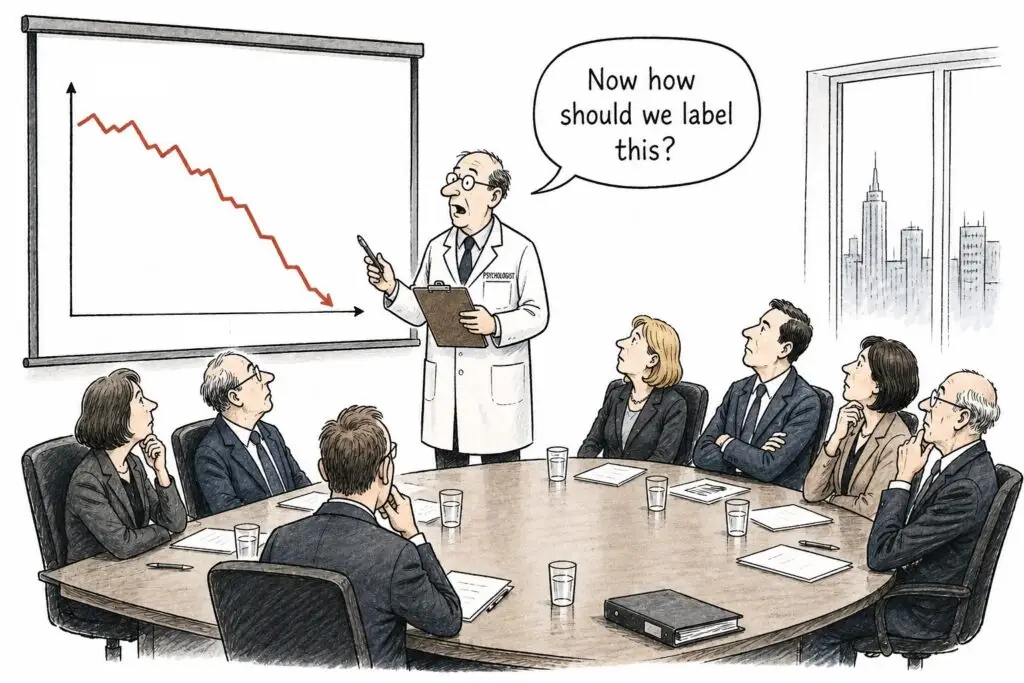
Humans in the Boardroom #5
I disliked Biology at school. It seemed to be all about remembering the names of bits of animals and plants, when what I really wanted to do was understand how nature actually works. It’s funny how many people believe that just labelling things solves problems.
We see this a lot in business at the moment. There is a fashionable discussion about powerful CEOs, and whether they are ‘narcissistic’ or even ‘psychopathic’. One recent academic study used the frequency of the word “I” in results conference calls and repetition of words in announcements as markers for narcissism!
It is no coincidence that these labels sound like insults thrown at someone we don’t like.
What is the real problem here? It’s probably that people feel that certain CEOs wield too much power and they don’t like the way that they do it. Is the individual the whole problem? Is the solution to place a psychological label on the CEO?
The underlying problem is more likely to be dysfunctional leadership combined with a steep authority gradient. The question isn’t what psychological label to attach to the leader, but whether that behaviour is impairing the performance of the team.
Imagine you are on the board of directors, and you appointed a bright, ambitious go-getting new CEO, but a year on, you begin to think that the CEO is proving difficult and too autocratic.
What do you do about it?
Reflect
What was the board’s role in this dysfunctional leadership problem?
- Think about why you appointed them in the first place. There’s a good chance that the very traits that you now dislike are more extreme examples of the ones that made you choose them in the first place. At what point does a ‘driven’ person become ruthlessly ambitious?
- Did they behave like this in previous roles, or has the situation in your company brought this out of them?
- Why is the CEO behaving differently to how you expected when you appointed them?
- Have you discussed the issues with colleagues and the CEO themself?
- Does the board stand up to the CEO and lay down clear ground rules and expectations?
You may well conclude from these questions that the board itself has played a role in the situation developing. Maybe blaming the CEO serves to divert blame from the board. So what do you do?
Act
- Write down the board’s expectations of how the leader should work both with the board and their subordinates.
- Discuss it with the CEO and judge their willingness to work towards these expectations.
- Make clear that the board will judge how results are achieved as well as the outcomes themselves, and reflect this in performance assessment and, where appropriate, remuneration.
- If the CEO proves unwilling to work with these expectations, the board will need to consider whether to accept this or make a change. If the former, the board should identify mitigations, such as making stronger personal relationships with the CEO’s subordinates and strengthening whistleblowing measures.
- When management makes proposals, insist that several different options are discussed as well and insist that other directors, executive and non-executive, discuss and challenge all the options.
- Increase the time that the board spends on reviewing means as well as ends, including the results of team and board effectiveness assessments.
Takeaways
If we are going to tackle team and leadership problems, we should avoid falling back on pseudo-psychology labels. Leadership is situational: It varies according to the circumstances, such as support from the team, leader’s stress levels and degree of success being achieved. People behave differently at different times and in different situations.
Unless the board deliberately appointed an autocratic leader, it should ask what has happened in the situation that it has created that is producing this behaviour. It is the board’s responsibility to go beyond judging the leader, to look for ways for the board to change its behaviour to develop better teamwork and reduce the dysfunctional authority gradient.
In short: Don’t put labels on people, understand how things work, and then fix them. That’s human behaviour, not biology.
This is the fifth in my newsletter series, Humans in the Boardroom. If you enjoyed this article, you can subscribe on LinkedIn for future editions exploring human performance, leadership and decision-making in the boardroom.
Previous newsletters are available here:
#3 – Not so Pretty Polly