Skip to content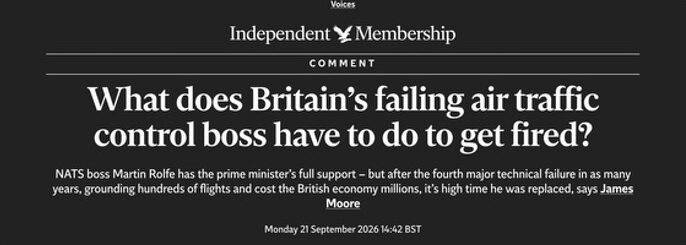
Humans in the Boardroom #8
The UK National Air Traffic system went down earlier this month. 2,000 flights were cancelled. The cost may well be as much as £100m (judging by the last major outage in 2023, which caused well over 1,500 cancellations). Hundreds of thousands of passengers were disrupted. There is one question we all want to ask: Who can we blame?
Martin Rolfe, CEO of NATS
Martin Rolfe is the number one target of commentators, with many calling for his head, including Ryanair, politicians and the Independent newspaper. The minister is reportedly meeting the NATS Chairman to discuss the CEO’s future. Rolfe is the figurehead and undoubtedly bears responsibility for his company’s performance, but is this the whole story?
The NATS Board
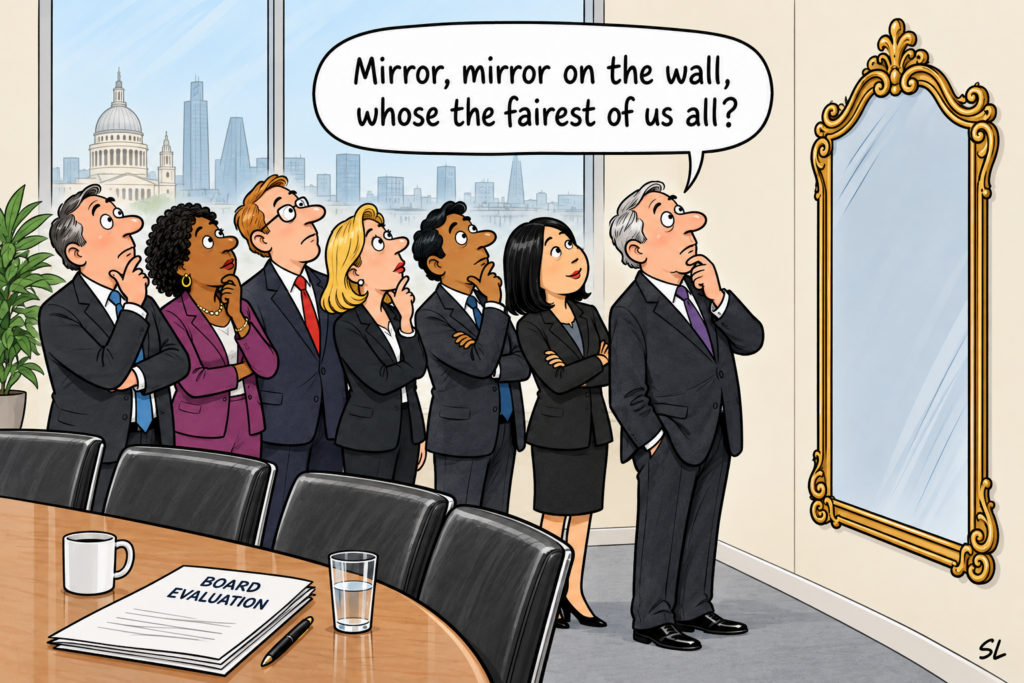
The board is responsible for the strategic direction, leadership and for ensuring that the group is run ‘safely, efficiently, effectively and legally’ (according to its own Annual Report). It sounds as if its board is therefore ultimately responsible. Does the board work well? The Board conducted an effectiveness review this year with an outside agency but, unusually, has not disclosed the results in the Annual Report.
The composition of the board is a chairman and five other non-executives, all appointed by the Airline Group, three non-execs appointed by the government, one Heathrow, Rolfe himself and the CFO. The Airline Group (comprising five large airlines) therefore has a majority of representative directors on the board.
The Financial Times has reported that NATS was operating its flight-processing system without immediate back up whilst it was conducting a major systems overhaul. If that is correct, it points to a board-level risk management decision: the cost of maintaining a duplicate system was seemingly considered too expensive against the probability and consequences of a major outage.
From a governance perspective therefore, the board bears ultimate responsibility for this failure: in setting the strategy that allowed it, for appointing and overseeing the leadership that managed it, for the risks it crystallised and for representing the airlines as the immediate customers who suffered.
But is this the whole story?
The Government
The UK government has a golden share, 49% of the stock, three representative directors and approval rights over the Chair. With known major outages in 2018, 2019, 2023 and now 2026, the government can’t say it wasn’t warned and isn’t represented. The government is also a beneficiary: Last year, NATS paid £171m in dividend, of which £86m went to the state.
The Market Structure
When the government transferred 51% of NATS in 2001 to private interests (46% to the Airline Group and 5% to employees), under a Public-Private Partnership, its objectives were to combine public safeguards and accountability with private-sector management, investment and commercial discipline. It received £800m from the share transfers and increased debt taken on by the company.
The then government argued that NATS couldn’t bear the full cost of any failure in its systems, because doing so might encourage the business to prioritise punctuality over safety. This means that NATS does not suffer the true financial consequence of its resilience failures. Instead, it has to reduce future charges to the airlines based on a formula. For the 2023 failure, NATS incurred a £1.8m penalty, which reduced airline charges. The actual airline losses were put at £65m, and the total cost up to £100m.
Would the board have concluded differently, you might ask, if it had weighed the full cost to airlines and passengers of a large-scale outage?
So who is to blame then?
Everyone involved shares some responsibility for what happened, apart from the ultimate victims, the passengers. But allocating blame is simply not helpful. The executives, including Martin Rolfe, run a system that failed badly. However, they were targeted and overseen by a board that included airline and government representatives.
However, ultimately, NATS seems to have been responding to perverse incentives. If a company, especially a natural monopoly, is shielded from the real costs of its failures, it is highly likely to deprioritise investing in its own resilience.
The argument that NATS must be protected from paying for the consequences of its own actions because that might cause even bigger safety risks is fallacious. Businesses routinely make investment decisions by weighing up the probability and consequences of failure that fall on customers, suppliers, employees or wider public, whether the risks are financial, environmental or safety-related. A board’s responsibility is not to ignore external costs just because someone else may end up paying them.
We have ended up with a three-legged donkey: commercial incentives drive NATS’s behaviour, except it escapes most of the financial consequences of its biggest risk. Drive the donkey too hard and that missing leg eventually brings the whole animal down.
Key Takeaways
- Boards should factor in all the consequences of risks, not just the ones that might affect their profit.
- Boards should be taking risk management even more seriously. The 2026 NATS Annual Report devotes just two paragraphs, out of a total of 191 pages, to business continuity and resilience risk.
- Executives must take responsibility for failures, but boards must take ultimate responsibility for their company’s decisions.
- Blaming people doesn’t usually help solve business problems. In this case, everyone involved in the governance and operations of NATS (the board, government, airlines and the regulatory structure) bears some responsibility for what happened. Scapegoating individuals can be a way simply for others to evade their own responsibility.
- If you set a company, board or executives up with perverse or incomplete incentives don’t be surprised if you don’t like the results.
- Boards should disclose their own board evaluation results. It doesn’t inspire confidence when these are withheld.
This at heart comes down to a company with insufficient incentives and consequences for its own failures. Air traffic control’s job is to ensure that the skies are transited safely and efficiently. It can’t do that if its systems stop working, because safety is paramount and that means aircraft have to be grounded. If there is no material cost to the operator when this happens, it will struggle to justify spending big money to ensure resilience.
In other words, if you load up a three-legged donkey, don’t blame the animal when it falls over.
My new book, “Why Companies Fail: Exposing Human Performance in the Boardroom” discusses blame, responsibility, incentives, leadership, risk management and many other board issues, and their role in corporate failures. Published this week, it is available from leading booksellers, as well as Amazon
This is the eighth in my newsletter series, Humans in the Boardroom. If you enjoyed this article, you can subscribe on LinkedIn for future editions exploring human performance, leadership and decision-making in the boardroom.
Previous newsletters are available here:
What BP’s board problem tells us about the human side
Tennis shows similar human behaviours to the boardroom
#3 – Not so Pretty Polly
From City darling to prison – how Polly Peck collapsed
#4 – Hidden Risks of Successful Leaders
Can success contain the seeds of destruction?
#5 – What’s in a name?
Psychological labels distract from understanding behaviour
#6 – Overconfident? Of course not
Overconfidence is a very common source of failure
#7 – Risk and Reward
Recognising that incentive schemes bring their own risks