Skip to content
Humans in the Boardroom #12
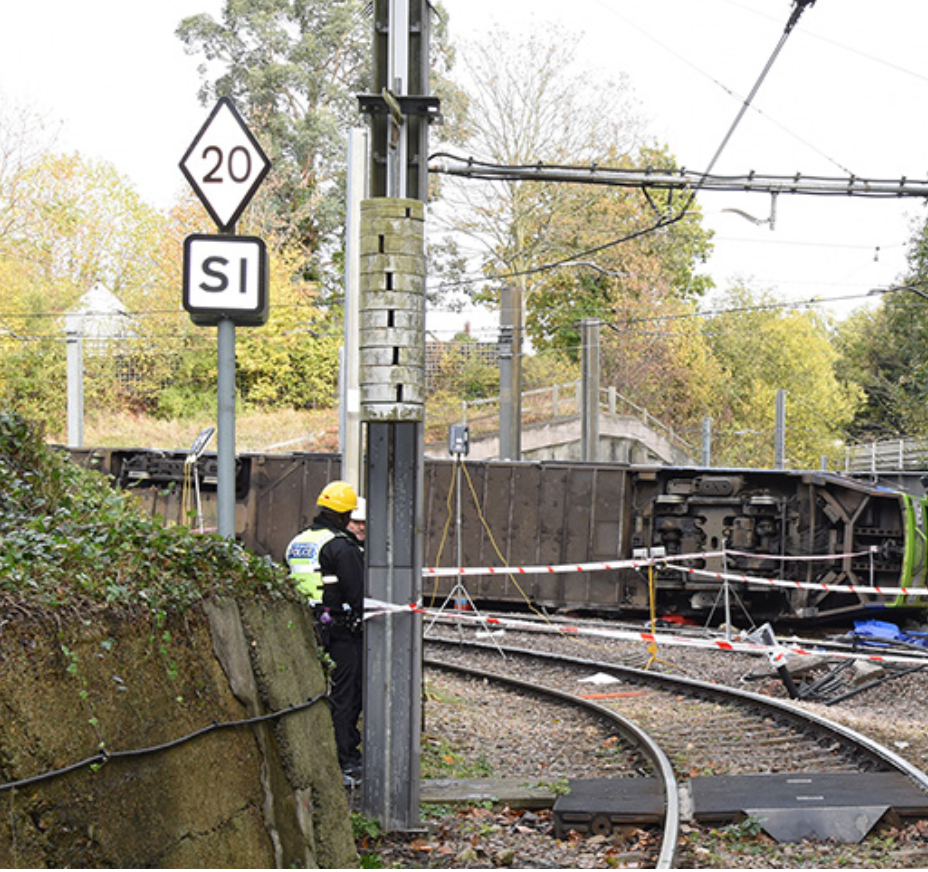
On a dark and rainy morning on 9 November 2016, a tram approached a sharp bend at more than three times the permitted speed. It overturned, killing seven people and injuring 19 others. The driver, a man with a previously impeccable safety record, had apparently lost awareness of his surroundings, possibly falling asleep momentarily.
It looks on the face of it as a clear case of operator error: for whatever reason, the driver was going too fast. But was he really the cause of this disaster?
Railways, and especially trams, are not suited to sharp turns. The curve was acknowledged as sharp, so a 20 km/hour speed restriction had been imposed. Yet the speed-limit signage was limited, less conspicuous than required would be required on roads, and placed right on the fatal curve (see the photo), with no advance warning. There was no automatic system to apply the brakes if the tram exceeded the permitted speed, nor any device to detect driver loss of awareness. There was no mechanism to share safety information and little evidence of common approaches to risk. There was moreover evidence of other drivers previously going too fast or having to brake very late.
The question then becomes more than why did a driver lose attention one morning. It becomes why was a system carrying passengers so dependent on one person recognising the danger and taking the correct action at precisely the right moment: One person not making a mistake every time a tram crossed this curve: 600 times a day, over 200,000 times a year.
The human failure behind the error
However carefully people are selected and trained, they will sometimes become tired, distracted or overconfident, misinterpret information or make the wrong decision. The question is whether an organisation has anticipated these possibilities and made adequate provision for them. Has the process been designed to be resilient to occasional, natural human error?
We know that all humans make mistakes. Moreover, we understand that boring, repetitive tasks, operating under pressure or fatigue all contribute to a higher error rate. Good process design therefore reminds operators of risks, puts barriers to stop them making errors, and then puts more barriers to stop any error that does happen from becoming a disaster. On the roads, authorities put road markings, distinctive red signage and speed limits to warn drivers, speed humps to physically alert drivers, speed cameras that flash to draw driver attention (as well as provide evidence), and cars manufacturers fit anti-lock braking, crash protection systems, driver alertness alarms and seatbelts to reduce the impact of a collision.
The implications for boards
When things go wrong, are we sometimes too quick to blame individuals, rather than to acknowledge our own role in a failure? Here are some things we can all do to avoid this:
- When we put in a new process or new system in the office, actively consider what will happen if someone makes an error. Don’t allow a situation in which one person making an error could cause a serious problem.
- Examine how a human error could cause a problem and identify how the process could reduce (a) the likelihood of such an error being made and (b) the impact of that error being made.
- Identify factors that might exacerbate the possibility of human error , such as repetitive or boring tasks, stress or fatigue, misleading or ambiguous instructions, and inexperience.
- Ensure that people are encouraged to report errors made by either themselves or others, so that the process can be made more resilient. When someone admits to making an error, do we criticise them, or ask how can we stop someone else making the same error?
- Errors should be listed, analysed, lesson learnt and new measures put in place to avoid a repeat. And we should keep a tally of near-misses, as well as full scale mistakes.
In other words:
- Avoid a single point of failure
- Mitigate the risks of human errors
- Communicate failures
- Learn from previous errors to avoid future ones
The wider lesson – responsibility
Individuals should be held accountable for their own mistakes. However, they should operate within a system that expects humans to make occasional mistakes. You cannot hold someone responsible for never making a slip. Systems or processes should be resilient to human error. If not, the prime responsibility sits with the system, its designers and its managers.
In this incident, the driver was acquitted, but the operators were heavily fined.
Boards should adopt a similar attitude to their own businesses. In Why Companies Fail, Stephen Jarvis and I examine corporate failures through the lens of human factors: situational awareness, attention, fatigue, pressure for example. It includes many examples of human errors that could have been avoided and mitigated if boards had sat down and thought about the risks and how to mitigate them, as well as over 50 initiatives Boards can do to avoid these problems.
_______
The facts in this article are based on the Rail Accident Investigation Branch’s investigation into the overturning of a tram at Sandilands junction, published in December 2017 and updated in October 2020. The Office of Rail and Road website page contains more information.
In memory of Dane Chinnery, Donald Collett, Robert Huxley, Philip Logan, Dorota Rynkiewicz, Philip Seary and Mark Smith, all of whom lost their lives in this tragic accident.