Skip to content
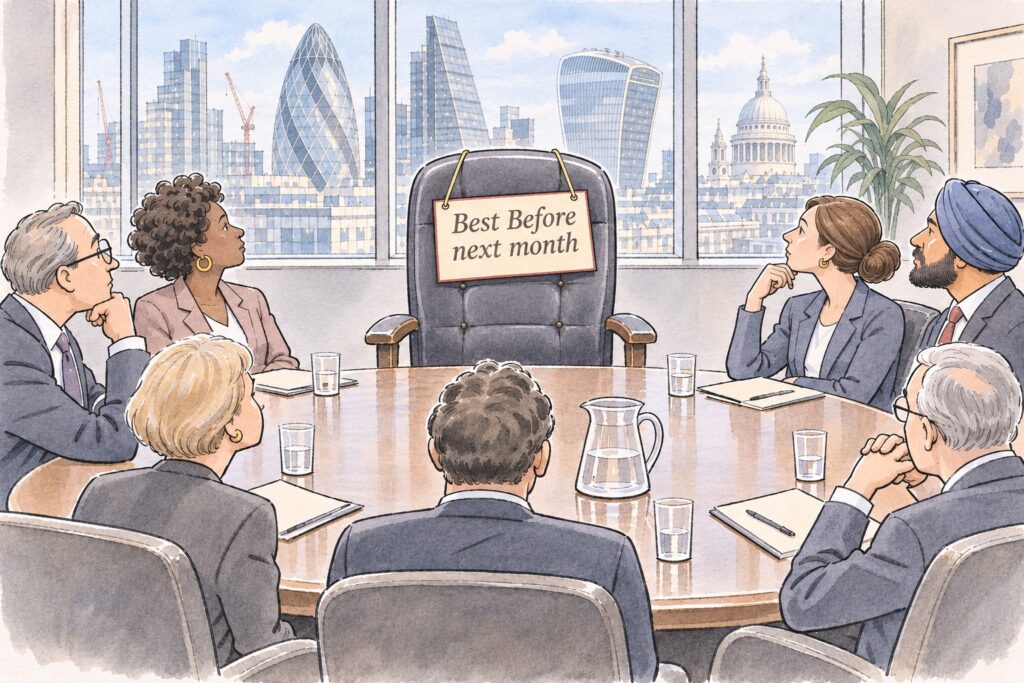
Power is a funny thing. When you have it, your limbs seem stronger, your jokes funnier and your thoughts more insightful. Yet when it starts to slip away, your movements seem more ponderous, your opinions less valued and your decisions less relevant. We all move on at some point, but it seems that the finiteness of a known date is the moment when the sands begin to slip away.
Boards see this particularly when a senior leader, especially a chair, CEO or CFO, announces their departure date.
Does it matter?
Companies are hierarchical organisations, so the shifting of power has a material impact. Boards may see that a departing leader is challenged more by subordinates (the authority gradient flattens significantly), which can be a major change, especially for an autocratic leader. The ability to take long-term decisions can also be severely weakened, with major decisions possibly being left to a successor. There may be jostling for position amongst senior management, perhaps to line themselves up as a successor, distance themselves from the ancien régime, or curry favour with a likely successor.
It is difficult for the outgoing leader too. They may start to shift their attention to their next challenge, perhaps reduce their manic working hours and pressure as it all seems slightly less important now. They may turn to their legacy, and think about how they might be judged later. None of this is necessarily conscious, and none of it means that the leader has stopped doing their job, but the dynamics around them can change quite significantly.
What can be done to handle an interregnum?
Boards should treat a leader’s known future departure as a risk and try to mitigate it.
- Have explicit discussions about the risks and document what the board decides it should do to manage them.
- Agree with the outgoing leader what they want to achieve in their remaining period, and what you don’t want to happen.
- Make clear to executives that the outgoing leader continues to have the board’s full support.
- Look for signs that teamwork is breaking down, such as less communication, more informal decision-making, increased risk-taking, greater diffusion of responsibility, public dissent or cliques becoming stronger.
This is also a real issue for interim leaders. I have served as a ‘temporarily executive’ chairman several times in the absence of a CEO, and found a tendency to lack confidence in the role (you are just a stand-in), avoid long-term decisions or decisions that might bind the permanent successor, worry about being bamboozled by more knowledgeable executives, and focus on keeping the day-to-day operation going without any major failures. You may also feel that others are watching you carefully to make sure you don’t overstep (and they probably are).
Good leadership is difficult. Outgoing, finite leadership is much harder still. If a board can discuss it amongst directors and with the outgoing leader, it can be managed. What you can’t do is carry on after the departure announcement as if nothing has changed.
The leader may still be in the chair, but everyone knows that the sands are slipping away.