Skip to content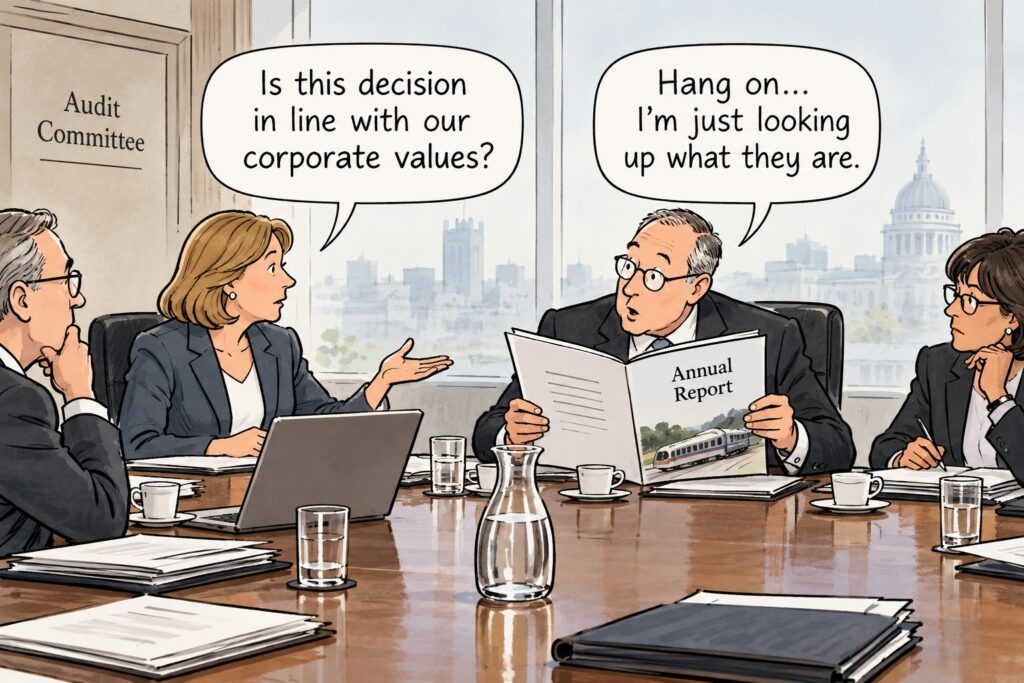
Humans in the Boardroom #9
Last week (on 8 Oct 2026), the Financial Reporting Council (FRC) slapped a severe reprimand and a fine of over £6 million on Deloitte for serious failings in its audits of Go-Ahead Group. For five years, Deloitte failed to challenge questionable decisions by Go-Ahead involving the retention of public money, breaches of good faith and the manipulation of reported profits.
But the more troubling question I think, is not about Deloitte’s poor audit, but how Go-Ahead got itself into this mess in the first place and why its own governance failed: Conduct that extended not just across its rail businesses, but even drew in the Group’s Audit Committee. How could a board that professed strong values and healthy challenge preside over such a failure of judgement?
What happened?
The scandal centred on London & South Eastern Railway (LSER), the Go-Ahead subsidiary that operated Southeastern services, but it was part of a wider pattern of accounting and control failures across its rail businesses. Under its franchise agreements, the Department for Transport (DfT) paid certain costs on a pass-through basis. For various reasons, some costs were lower than anticipated, leaving money that should have been passed back to the Department.
Over a number of years, the company used general, non-specific descriptions for balance sheet amounts, allocated income to earlier franchise periods to avoid sharing profits with the department, and took steps to minimise the risk that the overpayments would be discovered. The company accepted that the money was owed to the DfT, but it chose to retain the money as a reserve in its balance sheet. In some cases, it subsequently released amounts to its own profit, again without informing the DfT.
The then Transport Minister was unequivocal: “It was their specific legal duty to ensure that the money they accepted was correct. They did not. They actively obscured it.”
There is some evidence that the company took legal advice, although we don’t know what that said. Deloitte also recommended that the company discuss the matter with the DfT.
These problems were not unique to the LSER business. A second Go-Ahead subsidiary, London & Birmingham Railway, also released £5.6 million into profit after its franchise ended, with wording that obscured the nature of this amount. The FRC also identified serious audit failings in another UK and its German rail businesses.
In all, the DfT recovered £64 million from Go-Ahead in connection with LSER, and a separate £23.5 million penalty. The government didn’t renew the Southeastern franchise when it expired in October 2021, taking the operation into public ownership.
These were significant commercial and financial consequences, but the question of personal responsibility remains less clear. The Group CFO resigned as the scandal emerged, the CEO retired shortly afterwards, and a few rail executives also left. The Transport Minister declined to comment on whether the Serious Fraud Office was involved, and no criminal prosecutions have been launched.
Go-Ahead said that it was improving corporate governance through leadership changes, better compliance monitoring, greater focus on internal audit, and improved implementation of audit recommendations. Meanwhile, Go-Ahead itself was bought out by an Australian bus operator and a Spanish infrastructure group.
What was the board doing?
We don’t know when and how much the Go Ahead Group board knew about this misconduct. But the evidence about the Group’s Audit Committee is deeply troubling.
The DfT penalty notice records that the Group’s Audit Committee, comprising independent non-executives, considered the overpayments at two successive meetings in July and August 2019, and decided that the overpayments should again not be disclosed to the Department.
As an experienced Chair and CFO, I find it difficult to believe that the Group CEO and CFO were unaware of an issue of this materiality, particularly when it was being discussed at Audit Committee level. This all suggests that the issue was widely known in the Group Board.
What did they think they were doing? Did they regard the money as something the department might never discover? Did they focus on the accounting treatment and contractual technicalities rather than the underlying obligation? Did anyone challenge the proposition that retaining money known to be owed to the government was acceptable?
How did Go Ahead reflect on this?
In this context, Go-Ahead’s 2021 Annual Report makes for striking reading. The Chair wrote:
‘As well as an important purpose, Go‑Ahead has strong values. I am therefore very disappointed that these values were not reflected in the behaviours that contributed to failings in relation to LSER…’
The Report however acknowledged ‘serious errors’ and that ‘LSER breached its contractual obligations of good faith contained in the franchise agreements.’
Yet the Report reassured shareholders that:
‘The Board oversees and monitors culture in a number of ways to ensure it is aligned to our purpose, values and strategy.’
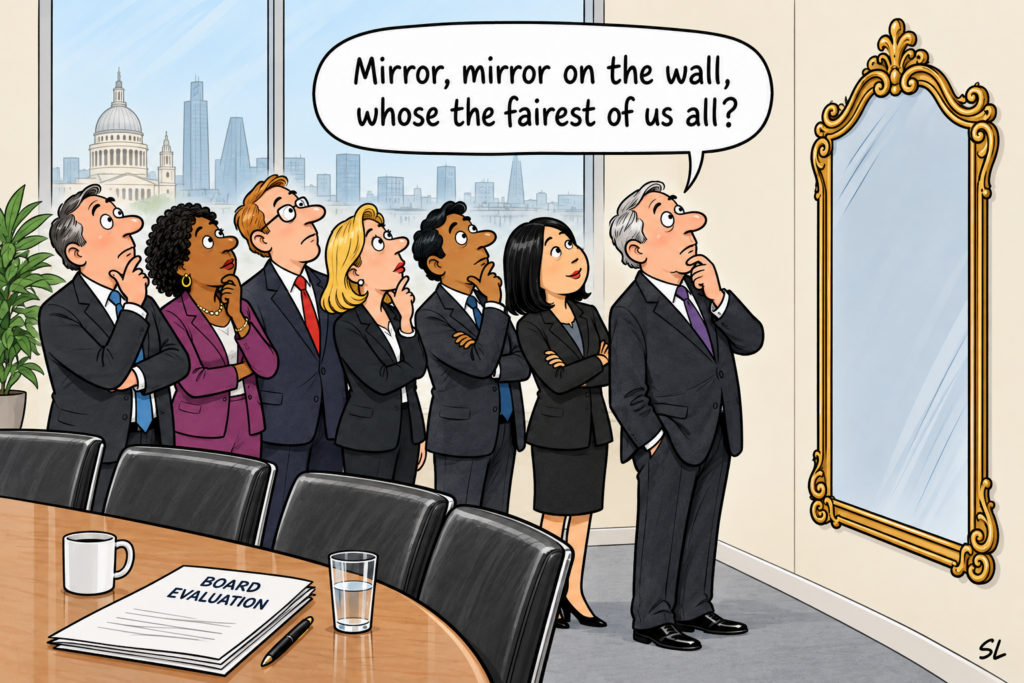
The disclosure of the 2020 board evaluation was also reassuring:
‘Built on a strong foundation of trust and respect, the Board demonstrated healthy dynamics with a high calibre group of people that operated within a culture of openness, transparency and healthy challenge.’
As for the Audit Committee which had decided against owning up to the DfT:
‘Findings from last year’s [2020] external effectiveness review undertaken by Independent Audit Limited concluded that the Committee continued to be effective in discharging its duties and responsibilities. The internal review carried out last Summer [2021] confirmed the external review’s findings.’
Incidentally, the word ‘ethics’ appears only twice in the Annual Report, once in reference to a non-exec director serving on another company’s ethics committee, and one mention of the Group’s Code of Business Conduct and Ethics which set expectations for its commercial partners.
The irony is hard to miss. It wasn’t that Go-Ahead lacked a statement of values, a code of conduct or formal governance arrangements. It was that these apparently coexisted with behaviour fundamentally at odds with those values and its contractual obligations. Even when this was exposed, the Board was unable to reflect on its own role and responsibility.
The human factors behind the failure
This case illustrates a central tenet of our research in Why Companies Fail: Exposing Human Performance in the Boardroom. Corporate failures cannot be understood simply by identifying the rules that were broken, or the people who should have spotted the problem. We cannot know precisely what was in the minds of directors at the time, but we should try to understand how poor or unethical decisions come to be made, accepted and sustained by capable people.
We know that unethical behaviour can become contagious. When someone in a position of authority takes a questionable decision, it can legitimise similar behaviour by others. Small departures from accepted standards can become normalised, each subsequent decision being judged against the last, rather than basic integrity and values.
Once an organisation has adopted a questionable position, there may be pressure to defend it, rationalise it or treat it as established practice. The discussion shifts from whether the conduct is right to whether it can be justified, then to technical arguments and contractual interpretations.
This may help explain the significance of the Audit Committee’s involvement. The Committee should have been the ethical ‘North Star’, testing the proposed course of action against the company’s values and good faith obligations, insisting on disclosure where money was owed.
The existence of a committee, a policy or an audit does not guarantee that anyone will challenge the ethics. Nor does a positive board evaluation prove that a board is exercising sound judgement when faced with an uncomfortable decision.
That is why simply adding more procedures is unlikely to work. Boards need to create norms in which difficult questions are asked, uncomfortable information is surfaced and decisions are tested for integrity and actual obligations, not merely against what may appear commercially advantageous.
The lesson for boards is clear: Ethics don’t belong to a code of conduct. They live in every decision that companies take. We shouldn’t rely on auditors to protect our ethics. If Boards are to show leadership, we need to live these values, even when inconvenient. And if we later realise we got it wrong, admitting so and reflecting on it – that can be the most powerful signal of all.
That’s the price of ethics.