Skip to content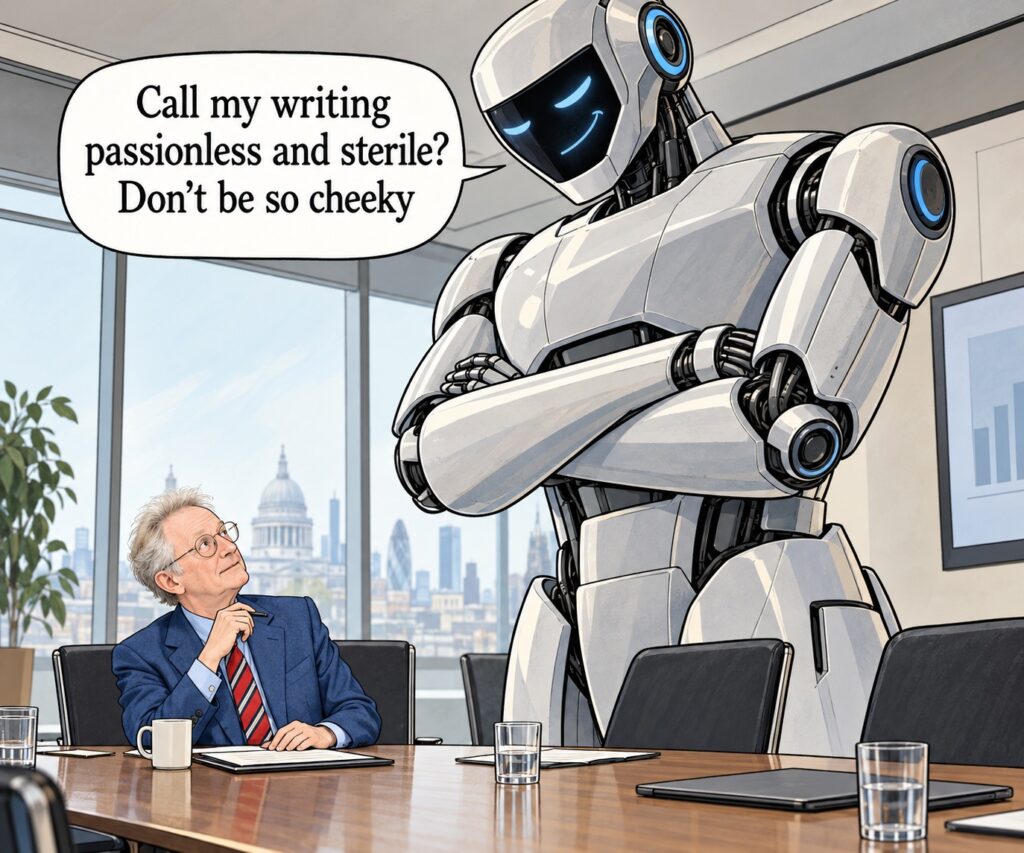
I bet I’m not the only person getting bored and irritated by articles that are clearly written by AI with little human intervention. This is particularly common at the moment in corporate governance articles. AI can be very helpful in many ways; fact checking, basic research or rewording an awkward sentence (as long as you bear in mind its tendency to make errors!). It can also be a good sounding board to discuss ideas and presentation. However, when a human delegates the ideas and writing of an article to AI, too often we end up with AI slop.
I thought I would set a thief to catch a thief, so with some help from AI, here are my tips to spot slop. You can use them as a bingo card in reading your next blog or Linkedin post.
Passionless Presentation
Explanation without experience
AI tends to like grandiose statements, but it has no lived experience like a human. It may opine that: “Strong Chairs lead the meetings”, but it won’t talk about a time when this really happened. If you see specific personal examples, it’s probably a human hand behind them.
Bland, passionless and difficult to disagree with
AI likes to say bland things that no-one can disagree with, such as: “The challenge for Chairs is to balance healthy disagreement with collective responsibility.” It initially sounds great, but it’s functionally useless.
AI lacks genuine passion: It might say: “Creating psychological safety is essential to ensuring that individuals feel empowered to challenge prevailing assumptions.”, whereas a human might write: “Things can get heated when non-execs challenge the CEO.”
Balanced alternatives, usually in threes
AI tends to default to basic juxtapositions and alternatives: “Not X, but Y. It isn’t about X. It’s about Y. Sometimes X. Sometimes Y. Neither X nor Y, but Z.”
A human might occasionally use this format, but the more often you see it, the more likely it is to be AI-generated. Humans are often taught the rhetorical power of three, as in “I came, I saw, I conquered”, but AI uses it compulsively.
Empty insights
AI is very good at sentences that sound insightful, but when you think about them, don’t really mean anything useful. Is a sentence there to inspire you to actually do something or just a quotable aphorism? Eg: “The Chair’s job is not to create consensus. It is to make sure disagreement gets heard before consensus is reached.” Sounds great, but it’s actually an empty statement.
Sterile style
Using abstract words
Keeping to general vagueness and platitudes, AI loves to use abstract words, such as; alignment, perspective, accountability, challenge, judgement, effectiveness, and collaboration. In contrast, a human might talk about an actual event, such as: “The Chair asks the CFO to justify the forecast”.
Repetition and one-sentence paragraphs
AI tends to keep telling you the same thing in different ways, each time often in a one sentence paragraph. Eg
“Consensus can be dangerous.
Agreement isn’t necessarily genuine alignment.
Silence doesn’t always mean agreement.”
Yes, yes, but by now a human is begging to move on.
So smooth
AI tends to be very polished and smooth, whereas humans can be idiosyncratic and include diversions. This is especially true when a human puts a lived example in, something the AI can’t of course.
AI will loftily declare: “The Chair creates the conditions for challenge requiring a careful balance between encouraging constructive disagreement and maintaining collective accountability”, whereas a human might write: “The Chair encouraged a good debate and there was some disagreement”.
Key Takeaways
Authors: Write the first draft yourself. Use AI for research, challenge or to improve awkward prose, but don’t outsource the thinking to AI and then claim it is your work.
Readers: Once you know the tell-tale signs, you’ll see them everywhere. You may not even need a bingo card.
Am I guilty?
Just to be fair, I did indeed ask ChatGPT if it thought this article was AI-generated. It rated it as 1.5/10 on its AI slop rating, commenting particularly on my uneven prose, specificity and obvious irritation as examples of human writing. I’ll take that as a compliment.
ChatGPT then went on to describe that last sentence as a ‘slightly cheeky, unnecessary human flourish’.
I’ll take that as a compliment too.