Skip to content
Humans in the Boardroom #13
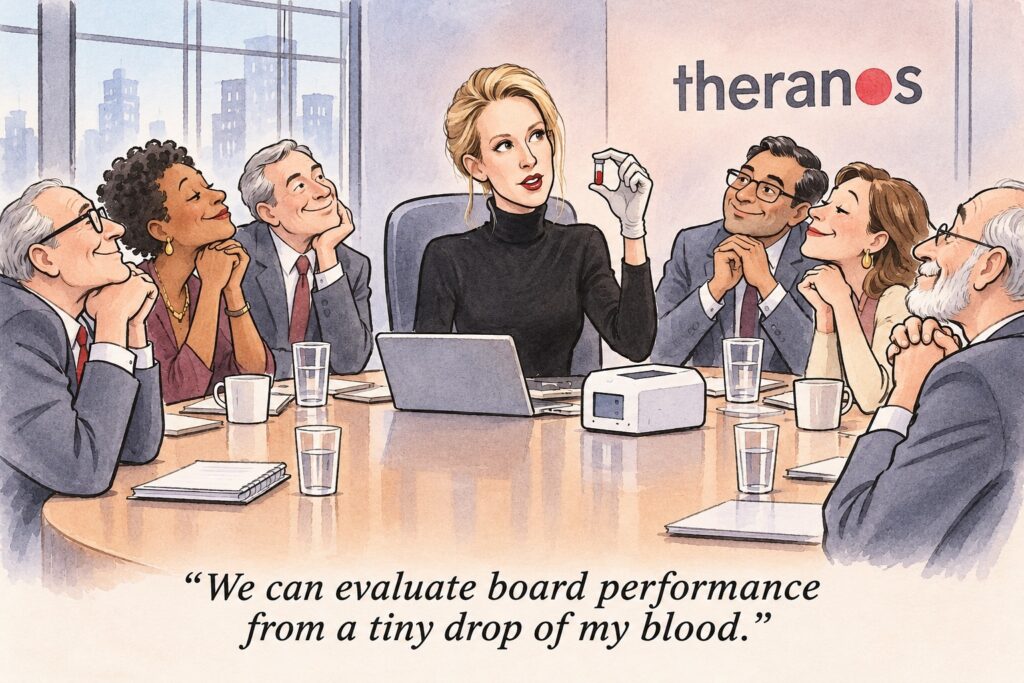
If only evaluating board performance were as simple as analysing a drop of blood. Instead, when governance fails, we are left reeling, asking: “What happened there?”. Theranos was such an extraordinary corporate failure: founded in 2003 by 19-year-old Elizabeth Holmes, it reached an estimated valuation of $9bn in 2014, was exposed as a fraud in 2015 and was dissolved in 2018.
Investors were left asking that question as they contemplated their losses. The exceptional new documentary, You Can See Everything, shows Elizabeth Holmes still portraying herself as unclear on what happened. Is she suffering from delusion? Or just extraordinarily naïve? Maybe she is a victim of domineering men around her? What is the truth?
The bare facts are not open for debate. The basic product – a portable blood-testing machine that could run a wide range of tests from a drop of blood – simply didn’t work as claimed: it couldn’t successfully analyse such a small sample. Somehow, this charismatic, very bright, dashing young woman built a huge business on devices that were either wildly inaccurate or secretly relied on third-party machines for their results. She appears to have believed that she could fake it till she fixed it.
Elizabeth Holmes may indeed have deluded herself. Delusion is a way that our brains cope with cognitive dissonance. We believe something strongly even when there is clear evidence that it is not true. It is easier for our brains to lash out or simply deny the information. We all do this in certain circumstances.
It is not uncommon in company failures to hear that business leaders were deluded or in denial of their company’s problems. Carillion’s chairman was described as maintaining ‘a delusional, upbeat assessment of the company’s prospects’ days before the collapse by a Parliamentary Select Committee.
How did an inexperienced, naïve, apparently delusional person come to serve as both CEO and chair of the board of a multi-billion-dollar company? As founder, it is understandable that she started out in those roles, but more surprising that she stayed there as the business grew. Maybe part of the reason was that she and ‘Sunny’ Balwani, who was President and COO, were in a secret romantic relationship? There’s keeping leadership tight at the top, and there’s turning decision-making into pillow talk.
What was the rest of the board thinking? It was a high-powered board, with figures such as Henry Kissinger, George Shultz and James Mattis, as well as former chairmen/CEOs of Wells Fargo and Bechtel. Yet Elizabeth Holmes held nearly all the voting shares, leaving the board with prestige, but lacking power to rein her in. Board meetings must have been heady affairs: Holmes was charismatic and inspiring, growth was stellar and the non-executives were paid $150,000 pa, plus some were paid large consultancy fees too, and in 2013 each received half a million shares (theoretically worth as much as $9m at peak valuation).
A high-profile board is no guarantee of success, particularly if directors fall into the trap of overconfidence, another common feature of boards failing. It can result from past success, but also from delusion and lack of challenge. All of these can make you agree more, question less and take things for granted. It’s very tricky for any of us to get off a gravy train going at full speed.
Lessons for us all
Delusion – We all suffer from it to some degree. Usually it is harmless, but when somebody’s belief becomes stated company policy, it can be rather more serious. Directors should question the evidence behind confident assertions, however impressive the author. Asking awkward questions is part of the job, even if they might imply the other party may be deluded about something.
Overconfidence – This can be deadly. We should always ask: What if we are wrong? What’s the worst that can happen? A premortem (ie you assume that It’s all gone wrong, then you work out why that might have happened) is a useful way to ask this without appearing to suggest management is deluded, complacent or plain wrong. If the Theranos board had contemplated that Holmes might not be telling the truth or that the technology simply might not work, had challenged the power of the couple running the company, or thought seriously about the worst outcome, they might well have avoided this scandal.
Whether you think Holmes was a chancer, fraudster, delusional or just naïve, she was one person on a board of 12. Responsibility for the scandal stretches beyond Holmes and Balwani to sit very firmly with the Board as a whole, including the other directors round the table. They failed for very human reasons: a lesson for all of us.
Now that’s the truth.
For more information:
- Theranos is one of many corporate failures discussed in more detail in my new book: ‘Why Companies Fail: Exposing Human Performance in the Boardroom’
- ‘You Can See Everything’ documentary in cinemas now
- ‘The Dropout’ a dramatisation of the Theranos story
- ‘Bad Blood: Secrets and Lies in a Silicon Valley Startup’ book by John Carreyrou