Skip to content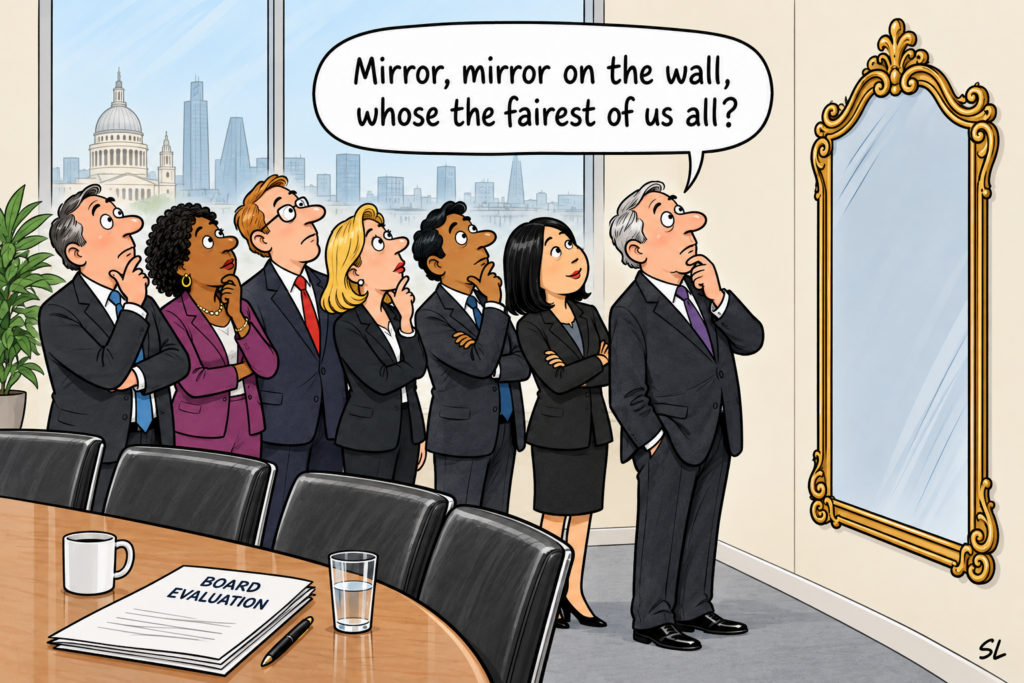
What do these three statements from company Annual Reports have in common?
“…the Board and its committees were discharging their responsibilities effectively”;
“Your Company continues to be led by a strong and balanced Board, which is well qualified to challenge, motivate and support the business.”;
“…the Board works well and operates effectively in an environment where there is constructive challenge from the non-executive directors.”
They are all statements arising from board evaluations reported shortly before their companies collapsed or were taken over in controversial circumstances: Northern Rock, Carillion and Autonomy. In each case, the boards were subsequently criticised.
We should take board evaluations seriously, but this illustrates the problem of boards effectively evaluating themselves, albeit sometimes with third party input. The directors were not necessarily being dishonest. They may well have believed at the time that they were doing well. But that, ironically, may have been part of the problem.
The issue however goes deeper and illustrates the importance of understanding human behaviour. The boards were accused of being over-confident: not taking enough account of risks, and not challenging management enough. Such overconfidence in fact features again and again in our analysis of major corporate failures.
There are two conclusions to be drawn. One is that it’s very difficult to be objective about yourself. Other peoples’ failings are often obvious to us, even more so with hindsight. Our own issues are harder to see because we know what we were thinking and intending, and can therefore explain away our actions when we would be much less forgiving of others.
The second point is that if we are overconfident, we are not going to diagnose that ourselves. Overconfidence, sometimes labelled as complacency, makes genuine self-challenge less likely. Of course, boards which are very confident will have a high opinion of their own efficacy. The problem lies with the process, not the people. Directors are simply acting as most humans would do in the circumstances.
Boards sometimes use external facilitators as well to help, but ultimately the evaluation is an assessment of the board by its own members. And boards are generally pretty self-satisfied. In the Annual Reports I’ve looked at, the least enthusiastic assessment of a board’s performance is ‘generally effective and well balanced’.
Board self-evaluations are not pointless, but their value is limited by normal human behaviour. They can be effective at highlighting individual views around the table. Some lead to a degree of introspection, but when it comes to one of the leading causes of board failure, complacency, they are almost bound to fail. Like a vampire, overconfidence has no reflection in the mirror.
What we see here is just one small example of the importance of taking account of human performance in understanding how boards work. We need to design boards around human behaviour and to compensate for it. The only way to spot overconfidence, before it leads to trouble, is to get independent, courageous third-party input, and to take it seriously. But real independence matters. A third party, who hopes for repeat business from the Chair or management team, may find it harder to provide genuinely challenging feedback.
Building on a base of good corporate governance, the extra insights that arise from human performance have the potential to make boards more resilient to human failings and less likely to lead to failure. We will know that board evaluations are valuable when a board actually admits in its Annual Report that it doesn’t work well, identifies why, and does something about it. Now that’s something to reflect on.
This article first appeared in the Times on 16 September 2026